
Cranberry Curd Tart — Recipe & Tricks
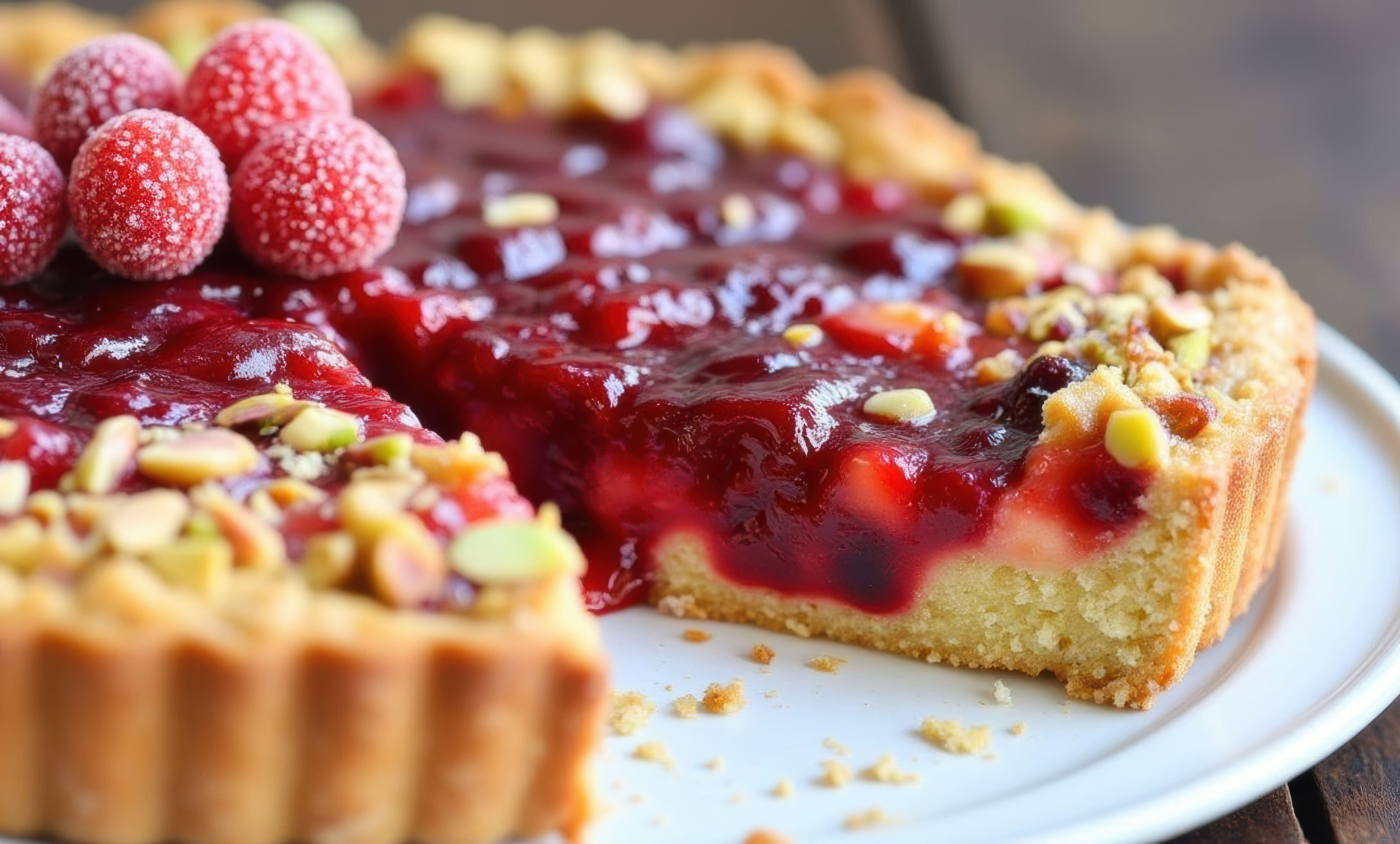
Table of contents
Introduction: why cranberry curd tart?
A short history of curds and tarts
Flavor profile: what makes cranberry curd delicious
Ingredient breakdown — what each part does
Equipment you’ll want
The recipe (9-inch tart): pastry, curd, assembly — step by step (US & metric)
Techniques: blind-baking, tempering, straining
Troubleshooting: common problems and fixes
Variations and adaptations (vegan, gluten-free, mini tarts)
Make-ahead, freezing, and storage
Serving, garnishes, and pairings (drinks & accompaniments)
Plating & photography tips — make it look as good as it tastes
Nutrition & portioning notes
Scaling the recipe for crowds
FAQs
Printable recipe card (clean & simple)
SEO meta: meta description, keywords, Open Graph suggestions
1. Introduction: why cranberry curd tart?
Cranberries are the bright superstar of late-fall and winter fruit: ruby red, naturally tart, and full of personality. When cooked down into a curd — thickened with egg yolks and finished with butter — cranberries transform into a velvety, concentrated filling. Spread inside a crisp, tender tart shell, cranberry curd becomes a festive, sophisticated dessert that’s surprisingly approachable.
This tart works for Thanksgiving or Christmas, dinner parties, or a weekend treat. It also plays well as a make-ahead dish: the curd stores in the fridge and the shell can be prepared in advance.
2. A short history of curds and tarts
The term "curd" historically refers to fruit curds thickened with eggs and sugar — lemon curd being the most famous English variety. Fruit curds were a method of preserving concentrated fruit flavor and making spreads or fillings long before refrigeration.
Tarts date back to medieval European cooking as simple pastry cases filled with sweet or savory items. Over the centuries, they evolved in French and English kitchens into refined vehicles for custards, fruits, and curds. Cranberry curd tart is a modern adaptation that brings North American fruit into classic custard technique.
3. Flavor profile: what makes cranberry curd delicious
Acidity / tartness: Cranberries are highly acidic. That brightness cuts through the richness of egg and butter, preventing the dessert from feeling cloying.
Sweetness: Sugar balances the tartness; finding the correct balance is key.
Texture: A glossy, silky curd set but spreadable, paired with a crisp, buttery crust, creates pleasant contrast.
Aromatic notes: Orange zest, vanilla, or a splash of liqueur (Cointreau, Grand Marnier) add complexity.
Temperature contrast: Chilled curd in a cool crust, or slightly warmer crust with chilled curd, changes how flavors shine.
4. Ingredient breakdown — what each part does
Tart shell (pâte sucrée / sweet tart dough):
Flour: structure.
Butter: fat and flavor; cold butter gives flakiness.
Sugar: sweetness and subtle tenderness.
Egg yolk: optional; binds and enriches.
Salt: flavor enhancer.
Cranberry curd:
Cranberries (fresh or frozen): base flavor; high acidity.
Sugar: balances tartness and helps set the curd.
Egg yolks (and sometimes a whole egg): thicken via protein coagulation.
Butter: enriches and provides gloss and spreadability.
Citrus (orange) and vanilla: complementary aromatics.
Cornstarch (optional): stabilizes for firmer texture without overcooking eggs.
5. Equipment you’ll want
9-inch (23 cm) tart pan with removable bottom (recommended)
Food processor or pastry cutter
Saucepan and heatproof mixing bowls
Fine-mesh sieve
Whisk, spatula, silicone spatula
Thermometer (instant-read)
Rolling pin
Parchment paper and pie weights or dried beans
6. The recipe (9-inch tart) — step by step
This recipe gives both metric and US measures. It yields one 9-inch tart (8–10 servings).
A. Ingredients — Tart Shell (Pâte Sucrée / Sweet Tart Dough)
250 g all-purpose flour (about 2 cups)
40 g powdered/icing sugar (about 1/3 cup)
1/4 teaspoon fine salt
170 g unsalted butter, cold, cut into cubes (about 3/4 cup + 2 tablespoons)
1 large egg yolk (about 18 g)
1–2 tablespoons cold water if needed (15–30 ml)
B. Ingredients — Cranberry Curd
350 g fresh or frozen cranberries (about 3 cups)
200 g granulated sugar (about 1 cup) — adjust to taste
3 large egg yolks (about 54 g)
1 large whole egg (optional for extra firmness) or an extra yolk for richer curd
80 g unsalted butter, cubed and chilled (about 6 tablespoons)
Zest and juice of 1 orange (optional — zest about 1 tbsp, juice 2–3 tbsp)
1–2 teaspoons vanilla extract or 1 tablespoon orange liqueur (optional)
Pinch of salt
(Optional) 1 teaspoon cornstarch mixed with 1 tablespoon cold water for extra stability
Notes: Frozen cranberries work perfectly. Adjust sugar based on cranberry tartness.
Step 1 — Make the tart shell
In a food processor, pulse flour, powdered sugar, and salt to combine.
Add cold butter cubes and pulse until mixture looks like coarse crumbs with pea-sized butter pieces.
Add egg yolk and pulse until dough begins to clump. If needed, add 1 tbsp cold water, pulse, add up to 1 more tbsp if dough is too dry.
Turn onto a lightly floured surface, press into a disc, wrap and chill 30 minutes (or up to 2 days).
Roll to a 11–12" circle (3–4 mm thick), fit into 9" tart pan, press into edges and trim. Chill again 15–30 minutes.
Blind-baking
Preheat oven to 190°C (375°F). Line shell with parchment and fill with pie weights or dried beans. Bake 15–18 minutes.
Remove weights and parchment, bake another 8–12 minutes until lightly golden and dry. Optionally brush the interior with beaten egg white and return briefly to set, which seals crumbs.
Let the shell cool completely before filling.
Step 2 — Make the cranberry curd
In a saucepan, combine cranberries and 1/3 cup (80 ml) water or orange juice and half the sugar (100 g). Cook over medium heat until berries burst and mixture reduces (8–12 minutes).
Press fruit through a fine sieve into a bowl to remove seeds and skins; you should have ~250–300 g of smooth puree. Return puree to pan if you want to reduce further to concentrate flavor.
Whisk egg yolks (and whole egg if using) with remaining sugar (100 g) until smooth.
Temper eggs: slowly whisk a ladle of hot puree into eggs, then slowly whisk eggs back into saucepan.
Cook on low-medium, stirring constantly, until mixture thickens and coats the back of a spoon, about 75–82°C (167–180°F). Avoid boiling.
Remove from heat and whisk in chilled butter, a few cubes at a time, until silky. Add orange zest/juice, vanilla or liqueur, and salt.
For the silkiest result, strain the curd through the fine mesh sieve again. Cover surface with plastic wrap to avoid skin and chill 2–4 hours until set.
Step 3 — Assembly
Spoon or pipe chilled curd into cooled shell and smooth.
Chill assembled tart at least 1 hour; 4 hours or overnight is better for clean slices.
Garnish ideas: dust powdered sugar, scatter sugared cranberries, pipe meringue or whipped cream, add toasted nuts or candied orange peel.
7. Techniques: blind-baking, tempering, straining
Blind-baking: Chill dough well, use weights to hold shape, and bake until the shell is dry and lightly golden. For extra protection, brush a thin layer of melted chocolate or beaten egg white to seal.
Tempering eggs: Warm the eggs gradually by adding a small amount of hot puree while whisking, then return to the pot. This prevents curdled eggs.
Straining: Cranberry seeds and membranes make straining essential for silky texture. Press firmly with a spatula to extract puree.
8. Troubleshooting: common problems and fixes
Lumpy curd (curdled): Caused by overheating. Strain to remove lumps. To rescue, whisk in a tempered yolk off-heat, or use an immersion blender and then strain.
Curd too runny: Under-cooked. Gently reheat and cook until it thickens, or stir in a small cornstarch slurry and cook to thicken.
Shell shrank: Dough overworked or not chilled. Chill longer and use pie weights.
Soggy bottom: Underbaked shell or very wet filling. Seal the interior with melted chocolate or egg white before filling.
Too tart or too sweet: Adjust sugar gradually; a pinch of salt or a tablespoon of butter can mellow acidity.
9. Variations & adaptations
Vegan cranberry curd
Ingredients swaps: replace eggs and butter with silken tofu or a combination of coconut cream and cornstarch as the thickening base, and finish with vegan butter or coconut oil for gloss. Cook the cranberry puree with sugar, blend until smooth, then thicken with cornstarch slurry and stir in vegan butter off-heat.
Gluten-free tart shell
Use a cup-for-cup gluten-free flour blend plus almond flour for tenderness. Chill and roll between parchment for easier handling.
Mini tartlets and bars
Use tartlet pans or a 9x13" pan for bars. Bake according to size (smaller pans need shorter bake times). Bars are perfect for crowd-pleasing portability.
Toppings and twists
Meringue: Swiss meringue works well for glossy, stable peaks.
Spiced: Add ground ginger or warm spices to the curd.
Boozy finish: Add a splash of bourbon or orange liqueur off-heat.
10. Make-ahead, freezing, and storage
Cranberry curd: Refrigerate in airtight container up to 7 days. Freeze up to 3 months; thaw overnight and re-emulsify if needed.
Baked crust: Wrap and store at room temperature 1–2 days, or freeze up to 1 month.
Assembled tart: Store chilled up to 2 days for best texture; freezing assembled tarts is not recommended.
11. Serving, garnishes, and pairings
Garnishes: Fresh or sugared cranberries, candied orange peel, toasted almonds or pistachios, whipped cream, or piped meringue.
Drink pairings: Sparkling wine (Prosecco or Champagne), late-harvest Riesling, citrus-forward cocktails (French 75), coffee, or Earl Grey tea.
Serving temperature: Slightly chilled or just below room temperature for best texture and clean slices.
12. Plating & photography tips
Use natural side light, a neutral or wooden background, and minimal props.
Overhead shots display the whole tart; 45-degree angles highlight layers.
Use a hot knife (dip in hot water and dry) for clean slices before photographing.
Garnish strategically: a few sugared cranberries, candied peel, and a sprig of green for contrast.
13. Nutrition & portioning notes
Approximate per slice (1/8th): 380–480 kcal depending on crust thickness and sugar. Fat 20–30 g; sugar 25–35 g; protein 4–6 g. For lighter options, reduce sugar or use a thinner crust.
14. Scaling the recipe for crowds
Double for two 9" tarts.
For a 9x13" tart bar, increase crust to 1.5x and curd to 2x for desired thickness.
When multiplying eggs, keep yolk-to-liquid ratios similar for consistent texture.
15. FAQs
Q: Can I use store-bought crust?
A: Yes — blind-bake and seal as recommended.
Q: Is cranberry sauce a good substitute?
A: Not directly. Cranberry sauce is chunky and lacks the egg-thickened richness of curd. You could blend and strain sauce and then convert into a curd by adding eggs and cooking gently.
Q: Can I can cranberry curd?
A: Canning egg-based curds is not recommended for safety. Refrigerate or freeze instead.
16. Printable recipe card — Cranberry Curd Tart (clean)
Yield: One 9-inch tart (8–10 servings)
Prep: 45–60 minutes active + chilling
Cook: 30–40 minutes crust + ~10–15 minutes curd
Tart Shell Ingredients
250 g (2 cups) all-purpose flour
40 g (1/3 cup) powdered sugar
1/4 tsp salt
170 g (3/4 cup + 2 tbsp) cold unsalted butter, cubed
1 egg yolk
1–2 tbsp cold water (if needed)
Cranberry Curd Ingredients
350 g cranberries (fresh or frozen)
200 g granulated sugar (adjust to taste)
3 egg yolks
1 whole egg (optional)
80 g unsalted butter, chilled & cubed
Zest & juice of 1 orange (optional)
1–2 tsp vanilla or 1 tbsp orange liqueur (optional)
Pinch of salt
(Optional) 1 tsp cornstarch + 1 tbsp water
Method (Summary)
Make dough, chill 30 min. Roll, fit into 9" pan, chill 15–30 min.
Blind-bake at 190°C (375°F) with weights 15–18 min, remove weights and bake 8–12 min until golden. Cool.
Cook cranberries with half sugar and water until burst; strain.
Whisk eggs with remaining sugar; temper with hot puree, return to pot and cook until thick (coat spoon).
Remove from heat, whisk in butter and flavorings; strain for silkiness, cool.
Fill shell, chill to set, garnish and serve.